A few weeks ago, a customer messaged us a photo of a small plastic knob — the one that opens the drawer on her nightstand. It had cracked clean in half. The nightstand was fine. The drawer was fine. One little piece of plastic was the only thing standing between her and a piece of furniture that worked. She asked a simple question: can you print this?
The question behind the request
That question is the whole point of this article. Nobody wakes up wanting a replacement part. They want the thing they already own to work again — the lamp that won't tilt, the vacuum with a missing wheel clip, the toy with a broken joint. A 3D printer is, at its best, a machine that makes the one piece the store stopped selling.
What breaks most often, and prints well
- Drawer knobs and cabinet pulls
- Clips, clasps, and retaining tabs
- Brackets, feet, and spacers
- Caps, covers, and plugs
- Small joints and connectors on toys and gadgets
What we need from you
A replacement part is only useful if it fits. We don't need the original design file — most people don't have one. We need three things, and a phone photo is enough to start.
- A clear photo of the broken piece, next to a ruler or a coin for scale
- The measurements that matter: the diameter of the hole it fits into, the thickness of the tab, the distance between screw holes
- How the part is used: does it carry weight, does it get hot, does it flex every time you use it
Why the material matters more than the shape
A knob printed in the wrong material will look identical to the original — and snap the same way the original did. Most decorative replacements print beautifully in PLA: it is rigid, prints cleanly, and takes color well. But a part that lives near heat, carries a load, or gets flexed every day usually needs PETG: tougher, a little more forgiving, and far better with warmth. Choosing the material is half the job; the shape is the other half.
The three things that make or break a reprint
- Fit — a part a fraction too tight won't go in; a fraction too loose will rattle. When the tolerance is tight, we print a test fit first.
- Direction — a 3D print is strongest along its layers and weakest across them, so a clip that bends across the layer lines will snap. We orient the print so the stress runs the right way.
- Thickness — the original part was injection-molded, which is stronger per millimeter than a print. A reprint often needs slightly thicker walls in the places that take the force.
When a reprint is not the answer
Honesty matters here. Some parts should not be reprinted: anything safety-critical — a part that holds weight over your head, a component in a car's braking or steering, a piece that sits inside something that gets very hot. And anything that touches food or drink while hot is off the table too. If a replacement isn't safe in plastic, we'll tell you — a working appliance isn't worth a bad fix.
Nobody wants a replacement part. They want the thing they already own to work again.
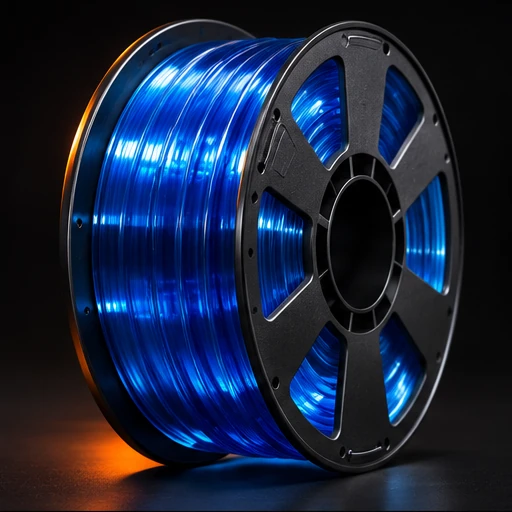 Illustrative imagePETG Basic
Send us a photo and the measurements — we'll tell you honestly whether we can reprint it, and what it would cost.
Start a custom project